
HPLC columns
- Packaging Unit PCE$819.00 Bulk price $794.43
- Packaging Unit PCE$775.00 Bulk price $666.04
- Packaging Unit PCE$620.00 Bulk price $610.70
- Packaging Unit PCE$1,534.50 Bulk price $1,358.81
- Packaging Unit PCE$496.00 Bulk price $427.49
- Packaging Unit PCE$578.15 Bulk price $569.47
- Packaging Unit PCE$565.75 Bulk price $404.58
- Packaging Unit PCE$592.10 Bulk price $534.36
- Packaging Unit PCE$773.45 Bulk price $726.95
- Packaging Unit PCE$682.00 Bulk price $464.41
- Packaging Unit PCE$616.90 Bulk price $463.22
- Packaging Unit PCE$612.25 Bulk price $496.19
- Packaging Unit PCE$496.00 Bulk price $416.07
- Packaging Unit PCE$550.25 Bulk price $462.86
- Packaging Unit PCE$461.90 Bulk price $378.00
- Packaging Unit PCE$550.25 Bulk price $478.95
- Packaging Unit PCE$647.90 Bulk price $556.45
- Packaging Unit PCE$1,157.85 Bulk price $1,054.00
- Packaging Unit PCE$768.80 Bulk price $644.57
- Packaging Unit PCE$523.90 Bulk price $430.90
- Packaging Unit PCE$680.45 Bulk price $554.90
- Packaging Unit PCE$756.40 Bulk price $656.50
How to Choose the Right HPLC Column
The right HPLC column depends on your analytical method (e.g., reversed-phase or normal-phase), the stationary phase material, particle and pore size, and instrument compatibility. In modern liquid chromatography, the column is one of the most critical components for achieving high efficiency, reliable retention rates, and reproducible separations. Our shop offers durable, high-performance columns from leading brands such as Hamilton, Shodex, Inertsil, Hypersil, Kromasil, and LiChrospher for precise and consistent analytical results.
Understanding HPLC Columns and Their Components
The column is the core component of any HPLC system. It contains the stationary phase, where molecules interact based on polarity, charge, or other chemical properties. Together with the pump, injector, detector, mixer, and mobile phase, the column determines resolution, efficiency, retention time, and pressure. Each element contributes to the chromatographic performance, making it essential to select compatible components for your system.
Choose by Method: Normal-Phase vs. Reversed-Phase
Normal-Phase Chromatography (NP)
Normal-phase chromatography uses a polar stationary phase and a non-polar mobile phase. This approach separates compounds based on their polarity and is suitable for chemical mixtures containing polar analytes. Solvents such as hexane, isopropanol, or dichloromethane are often used. The technique can separate ions and cationic molecules under specific conditions, but requires careful control of solvent composition and flow rate to ensure reproducibility.
Reversed-Phase Chromatography (RP)
Reversed-phase chromatography is now the most common HPLC mode. It features a non-polar stationary phase and a polar mobile phase, providing stable and predictable retention behavior for a wide range of organic compounds. C18 and C8 columns are the standard choice for separating non-polar or moderately polar analytes. RP columns offer high efficiency, stable pressure conditions, and strong molecular interactions through hydrophobic bonding, enabling accurate and repeatable chromatographic performance.
Tip: For routine aqueous samples, a C18 reversed-phase column is often the ideal starting point.
Stationary Phase Materials and Packing
The stationary phase is made of porous particles that serve as the foundation for the chromatographic process. The type of chemical bonding and surface treatment determines the selectivity and strength of molecular interactions. High-quality packing materials reduce void volume and maintain stable flow and pressure throughout the run.
| Material | Characteristics | Typical Use |
|---|---|---|
| Silica | Polar, classic support with strong surface activity | Normal phase separations |
| C18 / C8 | Non-polar, hydrophobic packing | Reversed phase, organic compounds |
| Amino / Diol | Medium polarity, good ion-exchange properties | Carbohydrates, HILIC methods |
| Phenyl | Aromatic interactions with π-π bonding | Complex organic molecules |
| Cyano | Moderate polarity, balanced retention | Mixed-mode applications |
Modern column packing is pressure-resistant, chemically stable, and optimized for fast, efficient separations. Advances in surface chemistry have improved column lifetime and reproducibility.
Particle and Pore Size
The particle size affects separation efficiency, flow rate, and back pressure during the chromatographic run. Smaller particles create narrower peaks and better resolution but also increase system pressure. Larger particles are more suitable for preparative or high-throughput chromatography.
- 1.5–3 µm: Highest efficiency, sharper peaks, higher system pressure
- 5 µm: Standard for most analytical separations
- 10 µm+: Ideal for preparative or industrial-scale applications
Pore size determines which molecules can interact with the stationary phase. Typical pores range from 25–1000 Å and affect the accessibility of analytes and retention rates. Our shop offers columns with 100 Å, 120 Å, 150 Å, 250 Å, and 300 Å pores to suit various compounds and analysis types.
SFC Columns – The Eco-Friendly Alternative
Supercritical Fluid Chromatography (SFC) uses CO2-based mobile phases, which reduce solvent waste and operating costs. SFC columns (10–50 mm ID) provide fast and efficient separations of organic compounds while maintaining low pressure and high analytical performance. They are a sustainable, cost-effective complement to classical liquid chromatography.
USP Compliance and Method Variations
The United States Pharmacopeia (USP) defines strict parameters for chromatographic reproducibility. Variations within the following ranges are generally acceptable for equivalent results:
- Column length: ±70%
- Flow rate: ±50%
- Particle size: −50%
- Temperature: ±10 °C
- pH (mobile phase): ±0.2
Understanding these tolerances ensures accurate comparisons across different HPLC columns and maintains method integrity for regulated chemical analyses.
Accessories and Replacement Parts
For consistent chromatographic performance, all components of the HPLC system must work together. Our shop also provides:
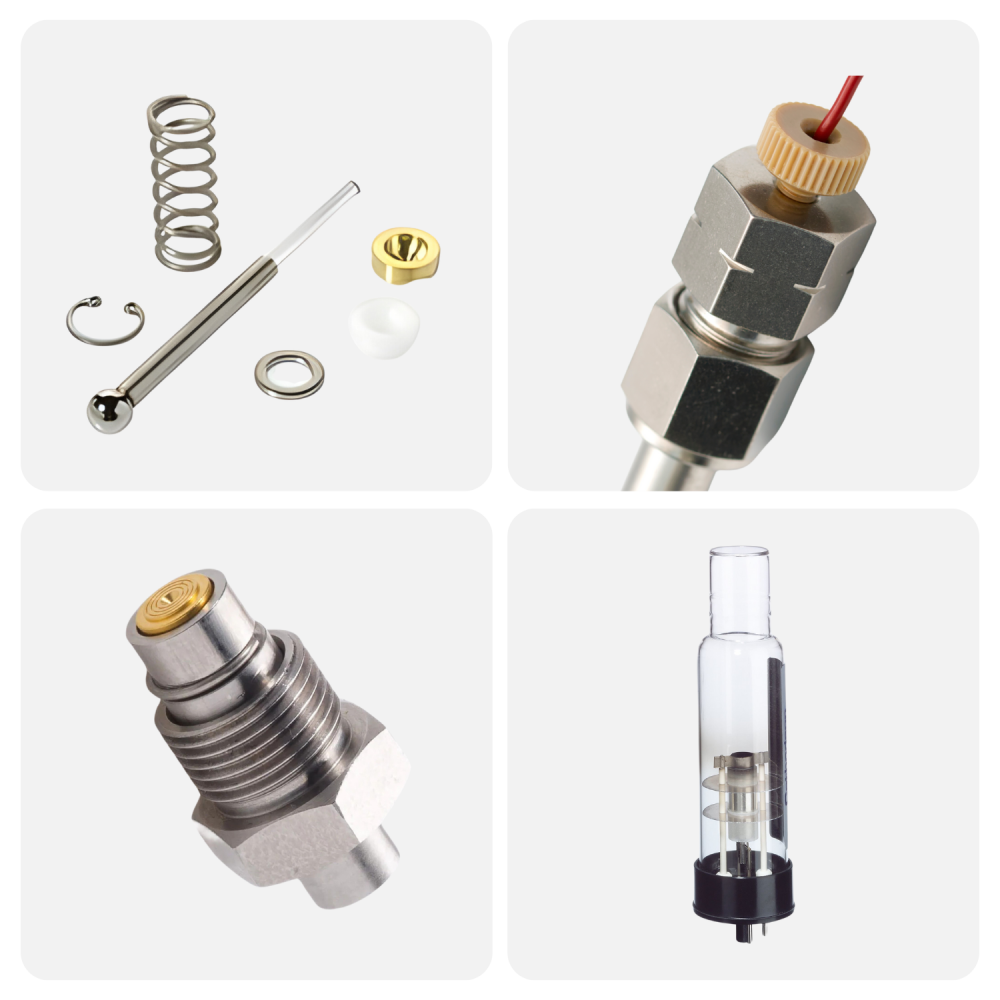
- Seals, valves, lamps, reservoirs, and fittings
- Guard columns and end fittings
- Spare parts compatible with major instrument brands
Proper system maintenance helps sustain stable flow, consistent pressure, and accurate peak shapes across repeated analyses.
Conclusion: Find Your Ideal HPLC Column
Define your method, analyte, and system compatibility to select the right column—whether reversed-phase, normal-phase, or SFC. Each chromatographic technique has its strengths, depending on the molecules and compounds under investigation. Our experts can help you identify the ideal packing, particle size, and pore structure for your chemical application.
Need assistance? Contact our specialists for technical guidance and personalized product recommendations.
HPLC Columns – FAQ
Which HPLC column should I use for my method?
Choose based on analyte polarity and chromatographic technique. Polar compounds are best separated with normal-phase columns, while non-polar analytes are more effectively separated using reversed-phase columns (e.g., C18).
What does C18 mean in HPLC columns?
C18 refers to octadecyl (18-carbon) chains chemically bonded to silica. This non-polar surface enables hydrophobic interactions for reversed-phase chromatography, offering consistent retention and reproducibility.
How do I select the right particle size?
Smaller particles (1.5–3 µm) provide higher efficiency and resolution but increase back pressure. 5 µm columns are widely used for standard analysis, while 10 µm and larger particles are preferred for preparative applications with larger sample loads.